
Galanthus (Snowdrops)
Hardy, early blooming snowdrop flowers for winter yards
Way before your daffodils awaken or crocuses push through the chilly ground, spotting these first flowers poking through frosty soil is the earliest hint that winter is finally breaking. When snowdrops bloom between January and March, these tough woodland perennials push right through the lingering cold with ease. While many people consider them a classic spring flower, snowdrops are actually true late-winter bloomers. They multiply steadily over time, creating beautiful clusters of nodding white flowers underneath the bare branches of deciduous trees. Hanging gently from thin, graceful stems, individual snowdrop flowers feature three milky-white outer petals that surround a dainty, emerald-speckled inner cup.
Showing 1 - 2 in 2 items
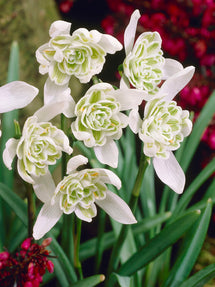

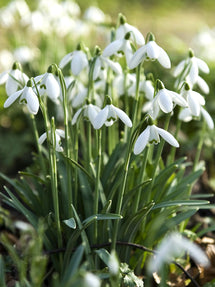
GALANTHUS BULBS - SNOWDROPS
Botanically named Galanthus, these long-lasting plants thrive in the cool, filtered shade under trees, tucked into garden beds, or naturalized right across your lawn. If left alone in damp, organic-rich soil, single clusters will eventually spread out into massive white drifts that reliably come back every single winter.
To help you grow these gorgeous late-winter carpets, DutchGrown offers premium snowdrops for sale across the US. We provide only top-size snowdrop bulbs, perfectly graded to ensure fast root growth before the deep freeze sets in.
Shipped directly to you from Holland, our dormant Galanthus bulbs arrive perfectly primed for fall planting. They will establish themselves quickly, bringing vibrant life to your quiet garden beds year after year.
Tracing the roots of the snowdrop
These diminutive winter bloomers trace their lineage to the limestone valleys and mountain woodlands of southern Europe and the Caucasus. Early European settlers tucked the bulbs into their luggage when sailing across the Atlantic, and the plants adapted immediately to cold northern soils.
Centuries later, self-sustaining colonies still bloom undisturbed around historic stone walls, shaded lanes, and colonial-era homesteads across the Northeast and Mid-Atlantic.
Their botanical name, Galanthus, stems from the Greek words for "milk flower"—a nod to the drooping, porcelain-white bells that hang from slender stems. While understated in appearance, these members of the Amaryllis family command a dedicated following.
That centuries-old collector obsession, famously dubbed "galanthomania," remains just as passionate today, with avid gardeners hunting down unusual markings and rare double-flowered forms.
Snowdrops also pull double duty as a critical lifeline for pollinators in early spring. The moment late-winter temperatures creep above 50°F, the petals open wide to offer fresh nectar and pollen.
For foraging honeybees and newly emerged bumblebee queens waking up to a barren landscape, snowdrops are often the very first meal of the year.
Top snowdrop species and varieties for naturalizing
While all snowdrops sport crisp white petals accented with green markings, distinct differences in height, bloom shape, and moisture needs set each type apart. Choosing between simple singles, ruffled doubles, or larger species comes down to your garden's sunlight, drainage, and planting plans:
- Galanthus nivalis (common snowdrop): The quintessential woodland bloomer, bearing solitary nodding bells on delicate 4- to 6-inch stems. With slender foliage and a tidy habit, it is the top pick for scattering across lawns or establishing under shade trees, where it self-propagates with ease.
- Galanthus elwesii (giant snowdrop): Noticeably larger blossoms on sturdy stems, framed by broad, blue-gray foliage. Originating from drier Mediterranean scrublands, this vigorous species typically blooms up to two weeks earlier and handles sunnier, well-drained garden beds exceptionally well.
- Galanthus nivalis 'Flore Pleno' (double snowdrop): A cherished heirloom variety packed with dense, ruffled inner petals that resemble tiny petticoats. Because they are sterile, these tightly packed blooms stay fresh longer and hold up remarkably well against harsh winter wind, rain, and late snowstorms.
Planting guide: Depth, spacing, and seasonal care
Getting snowdrops settled into the ground right away in the fall is key to healthy blooms. Unlike tulips or daffodils, Galanthus bulbs have thin, papery skins and lose moisture fast, so plan to plant bulbs promptly once your shipment arrives:
- Timing: Aim to get dormant bulbs in the ground between October and November. Planting in mid-to-late fall gives the root system plenty of time to take hold before deep freezes harden the soil, setting up strong late-winter growth.
- Soil prep: Snowdrops struggle in soggy, heavy clay. Amend dense soils with plenty of compost, leaf mold, or coarse grit to promote sharp drainage through wet winters while still preserving modest moisture during summer dormancy.
- Depth and spacing: Set bulbs roughly 3 to 4 inches deep with their pointed ends facing up. Space them 2 to 3 inches apart in loose, informal groupings rather than stiff lines to replicate how they naturally carpet woodland floors.
- Ongoing maintenance: Resist cutting back the leaves until they yellow and wither completely on their own, as this post-bloom foliage recharges the bulb for next season. Every three to four years, dig up and divide overcrowded patches to keep them blooming vigorously.
If you want the full step-by-step breakdown, check out our complete guide on how to grow snowdrops.
Why bulb size matters when ordering from DutchGrown
Snowdrop bulbs have remarkably thin skins, leaving them prone to drying out during storage and transit. If you start with undersized or dried-out stock, the bulbs simply lack the fuel to put down strong roots before ground freeze sets in.
That is why DutchGrown supplies only top-size Galanthus bulbs. Because they are fully mature, these premium bulbs are packed with carbohydrate reserves. This extra stored energy helps them root quickly in cool fall soil, giving you lush green growth and larger, healthier flowers in their very first season.
Backed by four generations of family growing experience dating back to 1882, we hand-select and grade every shipment straight from the fields in the Netherlands.
We ship them at peak quality right in time for fall planting, ready to go into the ground and naturalize into stunning winter color for decades to come.
Frequently asked questions about snowdrops
When is the best time to plant snowdrop bulbs?
Fall is the ideal planting window, specifically October through November. Planting before the ground freezes solid gives root systems plenty of time to anchor in cool, moist soil, setting them up for a strong emergence in late winter.
Can you grow snowdrops successfully from dry bulbs?
Yes, absolutely. While some gardeners purchase active plants "in the green" during spring, quality dormant bulbs planted in the fall settle in just as reliably. The secret is starting with plump, mature bulbs and tucking them into the ground promptly upon arrival so they do not lose moisture before rooting.
Do snowdrops multiply and spread over time?
Yes, they naturalize readily. Within two to three seasons, established bulbs expand through underground offsets and self-sown seed, gradually forming dense, spreading carpets. If an established patch becomes congested and blooming slows down, simply dig up and divide the clump right after the flowers fade.
Where should you plant snowdrops in your garden?
Snowdrops do best in dappled shade with loose, well-draining soil rich in organic matter. Tucking them underneath deciduous trees, along shrub beds, or directly into unworked lawn turf mimics their native woodland floor and provides the cool summer shelter they prefer.

